Wednesday, August 2, 2017

Wednesday Wisdom - I'll Be Happy When . . .

I'LL BE HAPPY WHEN . . .           


"Most people are about as happy as they make up their minds to be." 
  -- Abraham Lincoln 


In my work as a retirement planner, I meet lots of people who are not so happy today but who expect to be completely happy once they finally retire. I have my doubts.
I understand that some jobs are very grinding, and I recognize that some bosses or co-workers are a royal pain to be around. Thus, leaving such a caustic environment could definitely improve one's quality of life. But once the short-term euphoria of not having to work in those conditions has dissipated, I suspect those folks will soon find something else that makes life unpleasant for them. Then they will be waiting for that to go away so they can finally be happy.
The notion some people have that they can't be happy until such-and-such happens is a pattern that unfortunately sticks with them wherever they go. Waiting until __________ [whatever, fill in the blank] before they can finally be happy robs them of happiness today.
This is not to say that we can't look forward with eager anticipation to upcoming milestones like retirement, a nice vacation, or a special holiday. Nor does it mean that when life throws us a body blow, we shouldn't take a few days to absorb it and regain our equilibrium. But neither alternative should knock us off our innate sense of loving life as it comes.

I couldn't say it better than did writer Crystal Boyd:
"We convince ourselves that life will be better after we get married, have a baby, then another. Then we are frustrated that the kids aren't old enough and we'll be more content when they are. After that we're frustrated that we have teenagers to deal with. We will certainly be happy when they are out of that stage. We tell ourselves that our life will be complete when our spouse gets his or her act together, when we get a nicer car, are able to go on a nice vacation, when we retire.
"The truth is, there's no better time to be happy than right now. Your life will always be filled with challenges. It's best to admit this to yourself and decide to be happy anyway. Treasure every moment that you have.
"Stop waiting until you finish school, until you go back to school, until you lose ten pounds, until you gain ten pounds, until you have kids, until your kids leave the house, until you start work, until you retire, until you get married, until you get divorced, until Friday night, until Sunday morning, until you get a new car or home, until your car or home is paid off, until spring, until summer, until fall, until winter, until you are off welfare, until the first or fifteenth, until your song comes on, until you've had a drink, until you've sobered up, until you die, until you are born again, to decide that there is no better time than right now to be happy."
I like to be around people whose lives are filled with challenges, but who've decided to be happy anyway. I enjoy working and worshiping and socializing with folks who've determined that there is no better time to be happy than right now.
I relish spending time with people who've chosen to adopt Groucho Marx's attitude: "I, not events, have the power to make me happy or unhappy today. I can choose which it shall be. Yesterday is dead, tomorrow hasn't arrived yet. I have just one day, today, and I'm going to be happy in it."

To that I say, "Amen."

Wednesday, July 26, 2017

Wednesday Wisdom - When You're Here, Be Here

WHEN YOU'RE HERE, BE HERE          


"If you're always racing to the next moment, what happens to the one you're in?"
-- Unknown


Many of us have probably had this experience:  You're talking to someone during a reception, at a party, or after a meeting.  As you watch their eyes and body language, it becomes obvious they're looking past you and scanning the crowd for someone else they'd rather be talking to. 

From that moment forward, what worth does your conversation with them have for you?  Most likely very little.  You know their priorities aren't with you.  You feel devalued, minimized, maybe even a bit insulted.

Here's another situation for you to picture:  You're playing with your child or grandchild, or listening to your spouse, or chatting with a co-worker, but you're mostly thinking about how soon the big game will start, or how much you still have on your to-do list that day, or who that text is from that just pinged into your cell phone.

As they watch your eyes and body language, it becomes obvious to them that you'd rather be somewhere else or be doing something else.  From that moment forward, what value does your time with your child, your grandchild, your spouse, or your co-worker actually have for them?  Is it possible they might feel devalued, minimized, even a bit insulted?  When we're with another person and we are not present with them in that moment, it can cost us dearly in the quality of our relationships.

The heavy toll of trying to be in too many places at once isn't limited to interpersonal interactions.  Even when we're not with another person, the cost of not being in the moment may be substantial.   That's because not being present robs us twice. 

1.      Not being here when we're here means there's no way we can find joy or satisfaction or fulfillment in the present because we're not even there.  We're somewhere in the past or the future, either reliving bygone moments or imagining future days.  The present, with all its possibilities, is lost to us.

2.      In addition, we can't do justice to the past or the future or the present when we try to straddle now and then.   We're like the English soldier who "jumped on his horse and rode off in all directions."  The result of our multitasking is that everything gets short shrift.  When we try to do too many things at once we are ineffective and inefficient in all we do.

Every part of our lives has an important role to play.  As Thomas S. Monson said, "The past is behind, learn from it. The future is ahead, prepare for it. The present is here, live it."  But the key is to focus on one piece at a time. 

Reflecting on our past is valuable, especially as we glean important lessons from our triumphs and tragedies.  Planning for the future is critical to our ongoing success.  Set aside time for both; just don't do either when the here and now needs your attention. 


We do ourselves and those around us a huge disservice when we rush off to somewhere else when we should be here.  We fool ourselves when we think we can keep too many plates spinning at the same time.  We sacrifice a brilliant future and sully a golden past when we fail to live in the present.  When you're here, be here!

Wednesday, July 19, 2017

Wednesday Wisdom - Too Much Junk in Your Life?

TOO  MUCH JUNK IN YOUR LIFE?          


"When you live surrounded by clutter, it is impossible to have clarity about what you are doing in your life."
Karen Kingston  


I have found that Karen Kingston's comment above is true, not just as it applies to physical clutter, but also to what I read or listen to. Case in point:
Up until yesterday, I had two "friends" on Facebook who are polar opposites on the political spectrum. They are completely tuned in to the cable news outlets, and their dramatic reactions to each new headline are highly entertaining and perfectly predictable.
Each is absolutely certain of the correctness of his or her position, and each is quick to respond to the slings and arrows from across the aisle. Each is highly offended at the absurdity of the other side's viewpoints. Each argues that everything that is wrong with the world is the fault of the other camp.
I had determined many times in the past to block them, wanting to reduce the "noise" in my life. But then I would weaken and not do it, telling myself, "they help me keep my finger on the pulse of today's political climate."
But yesterday I woke up with a new resolve to get rid of more clutter in my life. It started with my bookshelves, where I threw out a dozen travel guides to places I have been and will never go back to. It continued in my closet, where I donated "extra" shirts and slacks that I never seem to get around to wearing. It went further as my digitization/scanning project continues to eliminate paper files.
Then I really got serious. I unfriended my aforementioned "friends." I came to the conclusion that constant venom like theirs is unhealthy, even if amusing and even if I might agree with some of it some of the time.
From now on, I want to spend my Facebook time with thoughtful, caring people, rather than angry people. I want to catch up on family news, meaningful milestones, and well-reasoned analysis. I want to be uplifted and in turn, I want to be uplifting.
To do that, I've established new guidelines for myself, whenever I'm thinking about speaking my mind on social media. If you're inclined to opine on current events and don't want to get black-listed, you too may want to consider these ideas:
  • Try taking a walk before telling your foes to take a hike.
  • Try giving them the benefit of the doubt before giving them a piece of your mind.
  • Try sleeping on it before pouncing on it.
  • Try toning it down rather than ratcheting it up.
  • Try building others up rather than tearing them down.

You may discover, as I have, that your persuasiveness increases when you lower your voice and think through your ideas before lashing out. You may catch others off-guard with a positive, common-sensical message rather than an angry one.

The essence of a joyful, abundant life is distinguishing between what truly matters and what doesn't; then getting rid of the junk and filling that space with sweet, kind, beautiful, loving, and eternal things. Sometimes I need to remind myself of this and act accordingly, including on Facebook.

Wednesday, July 12, 2017

Wednesday Wisdom - A Sister or a Brother is a Built-in Friend


A SISTER OR A BROTHER IS A BUILT-IN FRIEND
 

"Children of the same family, with the same first associations and habits, have some means of enjoyment in their power, which no subsequent connections can supply." Jane Austen 


Last week, business took me to my home state of New Mexico to facilitate a Family Council Meeting and Family Foundation Meeting in Santa Fe with a client family from Oklahoma. Afterwards I spent a few days with five of my own brothers and sisters who still live in the Land of Enchantment. It was deeply nourishing on many levels.
Ours was a large "yours, mine, and ours" family, with 13 siblings altogether. I was the second of my parents' seven children. My older brother Alan was killed on his bike by a drunk hit-and-run driver when he was 8 and I was 6. Two years later, my mother died of throat cancer. About a year after that, my father Marion married Elaine, a widow whose husband had died of leukemia. She brought her five children into the mix.
Marion and Elaine worked long and hard to meld us into a unified family. That idea eventually took root and we came to fully believe it. The birth of our youngest brother, Brent, helped to weld us together. Technically we may be wholes, halfs, and steps, but we don't think of ourselves that way. We're just brothers and sisters.
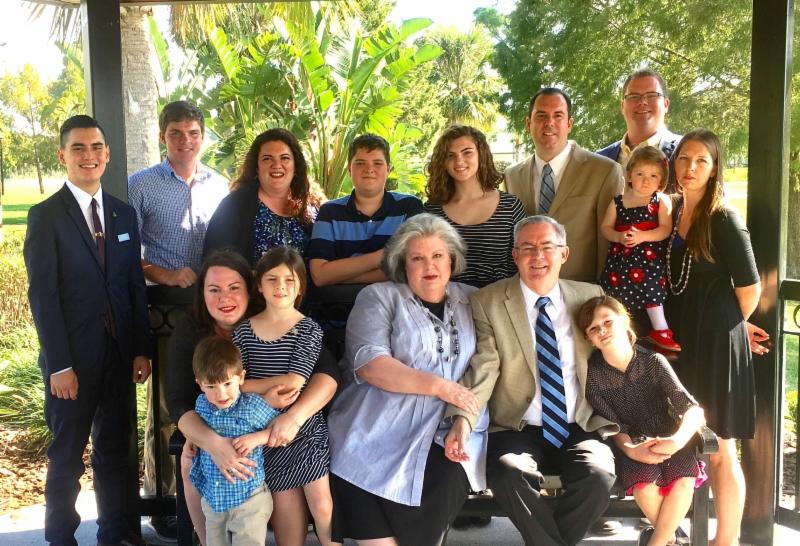
Before last week, I hadn't seen my brothers and sisters since our most recent siblings-and-spouses' reunion two years ago in Illinois, when we took this picture.


My visits with each of them were deep and rich and soul-satisfying. It's easy to "get down to the lick log," as they say in the South, when you've been through what we've experienced together.
The passing of the years and the extended distance don't change that. We've gotten slower and grayer, but that doesn't diminish our profound and timeless connection. We love being together. There's a unique and unbreakable bond among us.
Clara Ortega's description fits the relationship we now share: "To the outside world, we all grow old. But not to brothers and sisters. We know each other as we really are. We know each other's hearts. We share private family jokes. We remember family feuds and secrets, family griefs and joys. We live outside the touch of time."
It's a powerful thing to be with a group who all understand where we came from because we all came from there together. I'm beginning to appreciate the implications of Susan Scarf Merrell's observation that "[o]ur brothers and sisters are there with us from the dawn of our personal stories to the inevitable dusk."
We're not completely over the hill and we haven't faded into the sunset just yet, but as we approach our twilight years, it's comforting and reassuring to know we're not traveling that road alone. We're part of a circle of built-in friends. We are brothers and sisters.
I think Marion and Elaine would be proud of what we've become.

Wednesday, July 5, 2017

Wednesday Wisdom - Old Glory: Messy and Resilient

OLD GLORY - MESSY AND RESILIENT
 

"I believe that our Constitution is inspired and that it is based on principles that are timeless and universal. This is the reason why 95% of all written constitutions throughout the world are modeled after our Constitution." Stephen R. Covey


To the casual observer, the political scene these days seems fierce and messy, and indeed it is. There is serious and continuous rancor between and within the political parties; between the President and the Congress; between the House and the Senate; between the President and the courts; between the federal government and the states; and between the elected politicians and the professional bureaucracies. The press and the media have gone far beyond reporting the contention to becoming combatants themselves (although some would argue that they always have been but now have cast aside the guise of neutrality.)  It's almost sickening to watch.
I, for one, however, am not distressed by this unseemly scene. In fact, I believe our federal system of government was intentionally built to work this way and as long as it continues to do so, our nation will survive and thrive. Let me explain.
George Washington, Benjamin Franklin, and those other geniuses who gathered in Philadelphia in 1777 to revise and ultimately replace the Articles of Confederation, understood first-hand the dangers of an efficient and all-powerful monarch. Their vision was to create a "government of the people, by the people, and for the people," unlike anything else on the face of the earth.
These post-revolutionary patriots were no strangers to political conflict. As they met and sketched out the future of their country, they were required to balance and accommodate the competing and entrenched interests of small states and large states; Northern states and Southern states; delegates who wanted a strong central government and delegates who wanted a weak central government; those who trusted the will of the common people and those committed to government by the elites; those who wanted to copy the British model and those who wanted nothing to do with it; and many other contrasting viewpoints.
The wise and inspired structure they fashioned divided and disbursed the various levers of power among different branches of government and between the states and the national government. These competing interests were woven into an intricate tapestry of checks and balances that prevents too much power from accruing to any one official or group by pitting it against the interests of other officials, branches, and levels of government.
Their system also empowered individuals and non-governmental organizations to hold government in check by expressly safeguarding the right to vote, freedom of speech, freedom of the press, freedom of assembly, the sanctity of jury trials, the right to bear arms, and a long list of additional citizen-based rights and protections. They designed a limited government that would be subservient to the very citizenry it governed, an idea radically novel for its time that has become the gold standard for good governments everywhere.
The result of their magnificent efforts is a gloriously messy and inefficient system. As they intended, our government can't move forward unless a substantial plurality of citizens and officials agree on a given issue. Where a question is hotly debated and not clearly decided, government doesn't act. Is it sloppy and sometimes wasteful? Yes, indeed. But as humorist Will Rogers once insightfully quipped, "Be thankful we're not getting all the government we're paying for." That's the point of what our forefathers created - getting less government rather than more.
As frustrating and exasperating as this can be at times, the alternative would be governmental policies that vacillated wildly with the changing whims of the majority or the dictatorial leader of the moment. The rights of the minority would be under constant threat, and the reassuring political climate that is essential for growth and prosperity would be swept away. Much of what we have come to expect and appreciate as "the American way of life" could not survive in such a climate.
This model has been "stress-tested" in situations far more volatile and far more dangerous than today's tense environment. It has survived and "worked" through the westward expansion of the nation; during the bitter fight over the abolition of slavery and the Civil War; for the duration of the long decades of Reconstruction; as we fought two World Wars, the Korean War, the Vietnam War, and the long and tense Cold War; and throughout the terrorist onslaught of the 21st Century. It has stood the test of time.
Notwithstanding all the messiness - or to be more accurate - because of all the messiness, the United States of America is strong and resilient, a beacon to the world. It has provided us fortunate Americans with the highest levels of individual freedoms, the greatest degree of self-determination, and the most extraordinary material abundance the world has ever known. In fact, in the long history of this planet, no country has even come close to delivering to its citizens the measure of blessings we Americans enjoy. On this Fourth of July, I concur with Calvin Coolidge, who said, "To live under the American Constitution is the greatest political privilege that was ever accorded to the human race."
God Bless America!


Friday, June 30, 2017

Wednesday Wisdom--Find Your Core Joys: Some Father's Day Advice to My Grown Children--Part 3

Find Your Core Joys:  Some Father's Day Advice to My Grown Children - Part 3       


"God has blessed me with an amazing family, friends, and work colleagues that have been my joy, my support, and my sanity.  I don't know what I'd do without them."  Josie Loren  


Continued from last Wednesday . . .

Dear Children,
Over the past two weeks I've recommended that you create a written inventory of the activities that make YOU happy, and that you evaluate the quality and depth of happiness each of these activities gives you using "The Farnsworth Felicity Scale." (Remember, if you want to use different words or move the words around on the scale to suit your own personal lexicon, that's OK.)


This will allow you to apply the first two of three "stupidly simple and duh-obvious" principles that have the potential to greatly increase your overall happiness. They are:

1: Different things make different people happy.
2: There are different levels or degrees of happiness.

Here are the links for those articles in case you missed them:
In this week's article, I'd like you to consider how to apply in your own lives the third principle:
3: Life is sweeter when we share our core joys.
Once you've identified your "core joys," keep your list on the top of your mind. Pay attention to the Felicity Scale as you choose your friends and associates. Pray that God will bring to your attention those who share those same joys. And when you find those people, hug them and keep them close. Life is more fulfilling when you work with, play with, and live with people who find joy in the same things.
By way of illustration, I have a cousin who is a woman of adventure. That's one of her core joys. She has gathered a circle of close friends who share her love of outdoor challenges, and they are constantly hiking, camping, and exploring. From her photographs and stories, it is apparent that her happiness is multiplied as she and her cohorts enjoy their adventures together.
This issue is especially critical as you choose your life partner.  I recently wrote to one of my younger children:
I will suggest that seeking someone who shares your core joys will be one of the most important things you can do to have a sweet and joyful marriage. For example, one of your core joys (in my view) is being generous. It oozes out of you and brings great meaning to your life. You love to serve the elderly, the overlooked, and the less-fortunate. Now let's suppose you were "unequally yoked" to someone who did not share this as one of their "core joys." It's easy to see the kind of tension this would create in your family.
You can be on different pages in lots of ways that won't ultimately make much difference. However, if you are mismatched in your core joys, all the other similarities won't help that much.
I have thought a lot about why Marcie and I have enjoyed such a sweet, harmonious marriage, and I believe this issue is the key. In our early years, most who met us thought we were a completely asymmetric couple and many even expressed the thought out loud. I was a socially awkward farm boy from New Mexico who had never gone anywhere or done anything, and she was an outgoing Southern Belle with a much broader world experience. Our personalities were polar opposites.


But notwithstanding our outward differences, we just seemed to click from the moment we met. We found joy in the same things, and we were both very intentional about finding someone who shared those same core joys. As a result, from the beginning of our marriage we were close and supportive, and we have consistently remained so through the years. We have lived a joyful life together.
Thus, my formula for enjoying greater happiness in life is to understand and apply these three principles:
1: Different things make different people happy.
2: There are different levels or degrees of happiness.
3: Life is sweeter when we share our core joys.

The implementation of these principles is not extraordinarily difficult or beyond the reach of anyone. The ability to identify and prioritize core joys and surround ourselves with others who share them are essential keys to an abundant and rewarding life. Far beyond wealth, power, prestige, or material possessions, these steps will largely determine the quality of our time here on earth. 

Wednesday, June 21, 2017

Wednesday Wisdom - Find and Share Your Core Joys: Some Father's Day Advice to My Grown Children - Part 2

Find and Share Your Core Joys:  Some Father's Day Advice to My Grown Children - Part 2
 

"There is an expiration date on blaming your parents for steering you in the wrong direction; the moment you are old enough to take the wheel, responsibility lies with you."  J. K. Rowling 


Continued from last Wednesday . . .

Dear Children,
Last week I wrote that I have made three "stupidly simple and duh-obvious" observations about people, and that if you were to understand and apply these three principles in your lives, they would greatly increase your overall happiness. The first principle I mentioned is:
Principle No. 1: Different things make different people happy.
I invited you to thoughtfully inventory the activities that make you happy and to make a written list of those activities. I encouraged you to ask yourself, "When I am doing _________, I feel pleasure, happiness, or joy." I asked you to remember that this is your list and no one else needs to approve or disapprove.
This week, I want you to evaluate the activities on your list as you apply the second principle:

Principle No. 2: There are different levels or degrees of happiness.

Some things we do are fun, amusing, or simply pass the time. Other things we do have deep and lasting impact, with life-long or even eternal consequences. Other things are somewhere between these two contrasts.
I think a wholesome life includes a healthy mix of these activities. It is true, as the old saying goes, that "all work and no play makes Jack a dull boy," but it is equally true that, "all play and no work make Jack a poor and spoiled boy." Balance is required.
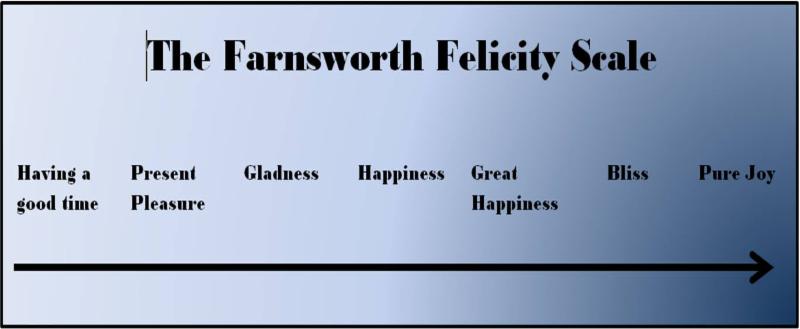
Let me introduce you to "The Farnsworth Felicity Scale." I picture a continuum of activities that add to our sense of well-being. On one end I see "having a good time." Near that is "present pleasure." Next on the scale is "gladness." Moving to the right is "happiness," followed by "great happiness." Then comes "bliss," and on the other end is "pure joy."


When I use the term "pure joy" I'm talking about those things that, at the very core of your being, fill you with deep meaning, a sense of purposefulness, and lasting satisfaction. These are things of enormous importance that lead to long-term happiness. When you do those things, you feel that you are being true to yourself and you are making a difference in the grand scheme of things.
I don't want to get tangled up in semantics; different people may use these various terms slightly differently. If you want to move the words around on the scale to suit your own personal lexicon, that's OK. The point is that different types of activities create different types of felicity or happiness for each of us. 
Now take the activities list you made in Step 1 and place each activity somewhere along the continuum of The Farnsworth Felicity Scale. With each activity, ask yourself, "When I do ____________, what is the length, breadth, and depth of the good feelings I experience? In what way and to what degree does this activity add to the quality of my life?"
Just as the list you made is for you and you alone, this process of evaluating the activities on your list is likewise for you and you alone. With any luck, it will give you significant insight about yourself, and lead you to a greater understanding of how to increase the quality of your own life. One key to a better life is to spend more time doing things that make you happy and less time doing things that make you unhappy. (Another "stupidly simple and duh-obvious" observation, I know, but how many people never seem to figure this out?)
In my experience, the most valuable outcome from this exercise is to identify for yourself those things that are located on the far right of your scale. Hopefully you will find a cluster of related activities that fit in the "pure joy" area of the scale. These I call your "core joys."
Identifying your core joys is one of the great discoveries of life. When you know what activities give you pure joy, you can start to focus on them. A second key to a better life is to spend more time doing things that give you a deeper, more meaningful, longer-lasting level of happiness. When you tailor your life by devoting more energy and time toward your core joys, you end up compounding your joy. That's when life becomes rich and sweet.
This should give you plenty to think about for the next seven days. Next week I'll talk about:
Principle No. 3: Life is sweeter when we share our core joys.


To Be Continued . . . .