Wednesday, June 27, 2018

Wednesday Wisdom: Farnsworth's First Law of Life, Leadership, and Bicycles - Part Two


FARNSWORTH'S FIRST LAW OF LIFE, LEADERSHIP, AND BICYCLES - Part Two
 

It's a lot easier to keep your balance when you're moving forward.  


My brother Lane has led hundreds of horseback trips into the San Juan Mountains in southwest Colorado in the past 40 years. He knows the mountains and he knows how to handle horses.  

Lane has found that experienced mountain horses generally work hard and are well behaved as long as they keep moving along the trail. However, if the trail boss loiters too long at the trailhead or stops too long or too frequently along the way, the horses start biting, kicking, and shoving each other. (There's a reason it's called "horseplay.") If that happens, Lane says, the leader must get the group back on the trail and moving forward as soon as possible.

According to Lane, the keys to successfully leading a train of pack horses are to (1) know where you're headed, (2) get moving, and (3) keep moving steadily toward your destination. Even though he's not likely to use or recognize the term, Lane understands and employs the underlying principle of Farnsworth's First Law of Life, Leadership, and Bicycles: "It's a lot easier to keep your balance when you're moving forward."


Lane and Scott on the trail in the Weminuche Wilderness in Colorado.


This principle pertains as much to humans as it does to horses and bicycles. Individuals, families, and work groups who apply the concept are more likely to be successful, while those who don't do so tend to be less successful.

I once worked with the head of a large organization with 10 divisions and 3,000 members. He had no clear vision of where the organization was going and was not enthusiastic about defining his vision, much less communicating it to the people in the organization.  

He saw his principal role as trouble shooting problems and putting out fires. When I suggested he should step outside his day-to-day tasks to define and share his vision for the organization, he resisted. How could he stop and do that, he asked, when he was already overwhelmed wrestling with problems and putting out fires?  

As it happened, there were always plenty of troubles and fires for him to handle. It seemed to me that by focusing on problems, he attracted more of them.  

At the same time, the lack of forward momentum caused the energy of the organization to be dissipated on petty internal concerns. Without direction and a forward-focused vision, the organization languished and the people in it were constantly squabbling, getting into mischief, and spawning emergencies. Dealing with these issues took even more of his time and made it even less likely that he would ever establish a clear vision of where they were going.

I have observed that heads of organizations who lack "that vision thing," as George H. W. Bush described it, have a difficult time rallying their troops or keeping them out of trouble. King Solomon wrote that "where there is no vision, the people perish." Proverbs 29: 18. Usually they die from marching in endless circles, from starvation, or from constant infighting.

Such officers may be in charge of organizations, but they are not leaders. Being a leader requires purpose, vision, direction, and forward movement.

The concept that it is impossible to keep a non-moving bicycle upright is not very complicated. As a former student once derisively described it, this principle is "stupidly simple and 'duh' obvious." "Everybody knows that!" he said.  

I fully agree.

And yet, knowing that, how often do we find ourselves in a swirl of crises because we don't have a clear vision and purpose?  

How often do we get bogged down in a swamp of minutiae and trouble because we forget to focus on our primary objective?  

How often do we allow interruptions and distractions to divert our attention and throw us off balance, draining precious energy and resources away from our main mission?

Sometimes, even if we don't yet know all the answers to how we're going to get to where we want to go, we simply must put one foot in front of the other and start moving.  

Often the answer is to just "head 'em up and move 'em out."  

When we do, we often find that forward momentum itself resolves or makes irrelevant the nagging issues that previously kept us paralyzed.  

Forward momentum itself gives us the energy to break through barriers that once seemed insurmountable.  

Forward momentum itself takes us to a place where we can see clearly how to reach our ultimate objective.  

Sometimes the solution to our quandaries is to get on our horses and start riding toward our destination.

Or as Lane would say: "Mount up and let's get moving!"


Tuesday, June 12, 2018

Wednesday Wisdom: Farnsworth's First Law of Life, Leadership, and Bicycles


FARNSWORTH'S FIRST LAW OF LIFE, LEADERSHIP, AND BICYCLES


Momentum begets momentum, and the best way to start is to start.
Gil Penchina 


Sir Isaac Newton figured it out in the world of physics over 300 years ago. His First Law of Motion states:

Every object will remain at rest or in uniform motion in a straight line unless compelled to change its state by the action of an external force.

The same principle applies in life and leadership. It requires a lot of energy to get moving; staying in motion is much easier. Once achieved, forward momentum in the right direction is a precious commodity and must not be squandered.

Momentum in life and leadership is an amazing thing. It dramatically magnifies our forward progress and makes huge objectives possible.

It also produces significant side benefits. Just as in riding a bicycle, forward motion in life prevents us from wobbling and tipping over. It eliminates wasted energy and makes it easier to stay on track. It reduces distractions and helps us stay focused on the things that matter most.

Farnsworth's First Law of Life, Leadership and Bicycles:

It's a lot easier to keep your balance when you're moving forward.

Momentum in the right direction is a beautiful thing. It can infuse a ho-hum life or a so-so organization with power and purpose. Here's a word to the wise: With all your getting, get going. And then keep going!


Wednesday, May 30, 2018

Wednesday Wisdom: The Call of the Wild . . . (The Wild Blackberry, That Is)


THE CALL OF THE WILD . . . (THE WILD BLACKBERRY, THAT IS) 
  

Isn't it curious how in so many of our pastimes and hobbies we play at supplying one or another of our fundamentally creaturely needs-for food, shelter, even clothing?  Michael Pollan


Is there a name for a question one asks when he isn't really interested in the answer to that question, but is actually fishing for different information or is trying to make a different point? I got one of those a few weeks ago from one of my children:

"Dad, how much do blackberries cost at Publix?"

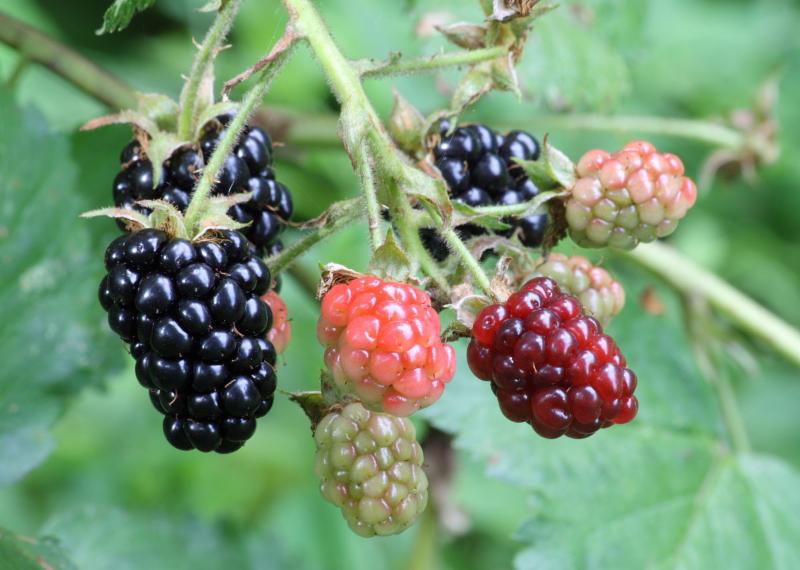
The actual answer to his question is around $3 or $4 a pint. But that wasn't what he really wanted to know. What he really was curious about is why every year about this time I put on my custom-made picking gloves and my thorn-resistant gear and head out to pick wild blackberries in the woods around Harmony, spending hours in the sweltering humidity, gingerly plucking those sweet morsels from among the vicious bushes.

I had to confess to him that accumulating berries is NOT the point of picking wild blackberries. If it were just about gathering berries, of course I could buy them at the store. Or I could go to a berry farm nearby where I could pick domesticated blackberries that have no thorns. But what's the sport in that?

Anyone who fishes or hunts could tell you, if they were candid and honest, that it would be far less expensive to buy their fish or venison or turkey or duck or elk or whatever at a store or butcher shop, than to buy a boat, fishing tackle, rifle, camouflage clothing, camping gear, duck blind, hunting or fishing license, and the hundred other things required to outfit a hunting or fishing trip. As much as they might want to prattle on about "free meat" for the freezer, truth be told, when you do the math, it's actually very expensive eating.

No, there seems to be something very primeval about securing "free" food from the wild.

To me, it probably started back in my early days as a Boy Scout in the arid landscapes of northwest New Mexico, when the "Handbook for Boys" challenged us to locate edible plants in our environment. Sure, perhaps a hearty outdoorsman could suck a little moisture from a prickly pear cactus or could stomach a few dandelion leaves from someone's ill-kept lawn, but that didn't really "count" as far as I was concerned.

Only after moving to the Southeast and discovering blackberries and other fruits growing wild and free did I feel I had actually completed that requirement from my scouting days. And once I was hooked on eating wild blackberries, my quest matured into figuring out how to harvest them without getting hurt by the thorns.


There have been times when I've overdone it, like the year I picked over five gallons of berries so we could make blackberry cobbler for 200 guests. Yes, that was over the top.

I've also been known to write three Wednesday Wisdom articles in a single year about lessons learned in the blackberry patch:


That too was a bit much.

But since then I've reined in my ambitions, and now a gallon or so is enough. This year I gave myself a deadline and even loaned my gloves to a friend so I wouldn't get too carried away.

At 66, it's OK to be wild. Just not too wild.